The Five Elements (Wu Xing) in BaZi, Explained
Every heavenly stem and earthly branch in your BaZi chart belongs to one of five elements — Wood, Fire, Earth, Metal, and Water. They're not literal materials; they're a shorthand for how the parts of your chart generate, support, or restrain each other, and they're the basis for most of what a BaZi reading actually says about you.
Written by the EightLetters team · Last updated July 2026
The two cycles
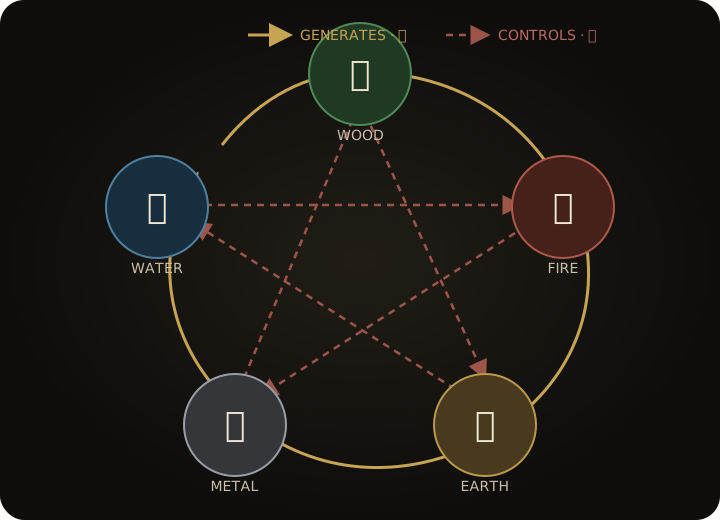
The elements relate to each other in two directions. In the generating cycle, Wood feeds Fire, Fire's ash becomes Earth, Earth bears Metal, Metal enriches Water, and Water nourishes Wood. In the controlling cycle, Wood's roots part Earth, Earth dams Water, Water douses Fire, Fire melts Metal, and Metal cuts Wood. Reading a chart is largely a matter of seeing where your elements fall on these two cycles relative to your day master.
Strong, weak, favorable, unfavorable
Your chart counts how much of each element is present — weighted by position (the month pillar carries more weight) and by the hidden stems inside each branch — to determine which elements are strong and which are weak. Separately, your day master's own strength is assessed: is the element of your day stem well-supported, or under pressure? From that, the elements that would restore balance become your favorable elements (喜用神), and the ones that push further out of balance become unfavorable (忌神). This is entirely chart-specific — there's no element that's universally "good" or "bad."
Frequently Asked Questions
What are the Five Elements in Chinese astrology?
Wood, Fire, Earth, Metal, and Water — five categories every heavenly stem and earthly branch in your BaZi chart belongs to. They're not literal materials; they're a shorthand for qualities and relationships used to read how the parts of your chart interact.
What does it mean for an element to be "strong" or "weak" in my chart?
It's a count of how much of each element appears across your four pillars, weighted by position and by the hidden stems inside each branch. An element with a high count is "strong"; one with a low or zero count is "weak." Your day master's own strength is a separate, related calculation.
What are "favorable" (Xi Yong) and "unfavorable" (Ji) elements?
Once your day master's strength is known, the elements that would bring it toward balance are your favorable elements — generally what a reading recommends leaning into. The elements that push it further out of balance are unfavorable. This is chart-specific: an element can be favorable for one person and unfavorable for another.
How do the Five Elements interact with each other?
Two cycles: the generating cycle (Wood feeds Fire, Fire creates Earth, Earth bears Metal, Metal enriches Water, Water nourishes Wood) and the controlling cycle (Wood parts Earth, Earth dams Water, Water douses Fire, Fire melts Metal, Metal cuts Wood).
Does the calculator show my Five Elements automatically?
Yes. Every free chart includes a Five Elements breakdown — the distribution across all eight characters, which are strong and weak, and which are favorable and unfavorable for your day master — as part of the standard reading.
Comments (0)
Sign in to leave a comment
No comments yet — be the first to share your thoughts